Most Analytics Look Back. RiskMap® Help RAS Looks Deeper.
Important insights about risk are often hidden beneath the surface of an organization’s own loss data.
RiskMap® is the proprietary analytical methodology originally developed by Alan Cantor. It was significantly upgraded at Risk Analysis Services to produce multi-analyses from various prospectives.
These analyses are carefully reviewed to uncover insights often unrealized.
RAS applies a data-driven approach often compared to “Moneyball for Insurance.”
Insurance pricing is often based on assumptions about how risk behaves — not always on what a client’s own data actually shows.
In many cases, the insurance market’s assumptions about a client’s risk profile differ materially from what the client’s own loss history actually demonstrates.
When that happens, organizations may be paying for risks that their data does not support.
Using RiskMap® to generate multiple reports from the client’s historical loss data, RAS carefully reviews and interprets the extensive reports and calculates the expected range of next year’s P&C losses.
These insights can materially affect how risk is priced, retained, and collateralized.
Clarity creates leverage.
Leverage improves negotiations.
What RAS Reveals
RAS helps organizations understand how their risk actually behaves.
Using the RAS methodology helps organizations understand:
How their risk actually behaves
Multi-year analysis reveals patterns in loss experience that traditional benchmarking often obscures.
Where the insurance market may be misinterpreting that risk
Industry assumptions and models sometimes differ materially from what the client’s own data demonstrates.
How those insights strengthen negotiations
A clearer understanding of loss behavior strengthens the client’s position when negotiating premiums, retention levels, and program structure.
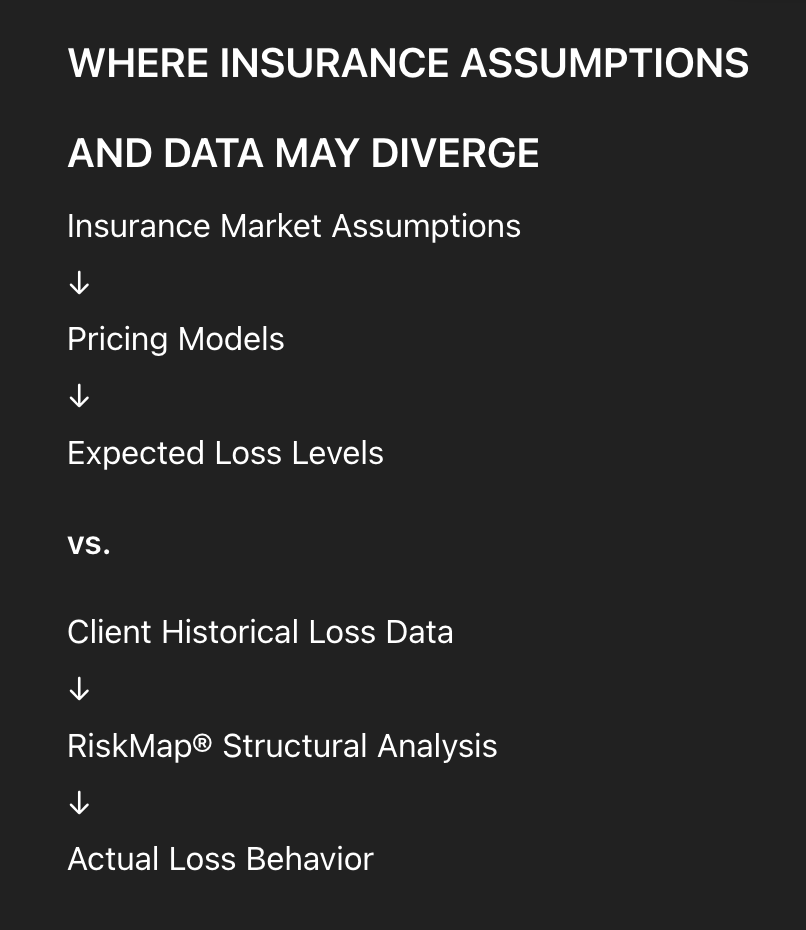
When “Expected Loss Levels” is greater than “Actual Loss Levels”, organizations may be paying for risks their data does not support.
What Makes RAS Different
Most insurance analysis focuses on summarizing past results or comparing performance to industry benchmarks.
RAS focuses on a different question:
What is the client’s loss history actually telling us about how risk behaves?
By examining multi-year loss data across multiple layers and retention levels, RiskMap® helps RAS reveal patterns that traditional reviews often overlook.
These include:
- Frequency versus severity behavior
- Multi-year loss development characteristics
- Claim clustering and volatility patterns
- Retention performance over time
- Structural characteristics influencing underwriting perception
- Loss layer behavior across successive retention levels
This is not simple trend reporting.
It is analysis of how losses behave.
Why This Matters
Traditional actuarial analysis often relies heavily on industry benchmarks and exposure models.
While benchmarking has its place, it can disadvantage organizations whose loss performance is materially better than their peers.
Since RAS focuses on the client’s own data, this often reveals that an organization’s actual loss behavior differs significantly from how the insurance market assumes it behaves.
When that happens, opportunities can exist to improve insurance program structure and pricing.
Identifying Opportunities Across Loss Layers
RiskMap® evaluates expected losses across multiple retention levels and risk layers.
This allows RAS to compare the client’s actual loss behavior with how the insurance market prices those same layers.
In some situations, the market may assume substantially higher expected losses than the client’s historical data supports.
For example:
- RAS analysis may estimate an expected cost of $100,000 for an additional retention layer
- The insurance market may assume that layer represents $900,000 of expected loss
- If the market offers a $400,000 premium credit for taking that layer, the client gains $300,000 of economic advantage
RiskMap® helps reveal where these opportunities may exist.
Strengthening the Client’s Negotiating Position
Organizations that engage RAS enter renewal discussions with a clearer understanding of their risk behavior.
This allows them to:
- Challenge assumptions with credible analysis
- Demonstrate actual volatility characteristics
- Clarify retention performance
- Correct overstated risk perceptions
- Present a clearer, data-supported narrative to underwriters
Who Benefits Most
RiskMap® analysis is particularly valuable for organizations whose loss performance may be misunderstood by the insurance market.
This often includes situations where:
- Projected loss forecasts consistently greatly exceed actual losses
- Actual loss performance is lower than industry averages
- Volatility assumptions appear greater than historical data supports
- Organizations reevaluating retention levels or program structure
When your loss history tells a stronger story than the market recognizes, clarity matters.
And clarity changes negotiations.
Why RiskMap®-Type of Analysis Is Rare
Most insurance analysis relies heavily on benchmarking models and industry assumptions.
Those approaches are useful for broad comparisons but rarely examine the detailed structural behavior of an individual organization’s loss history across multiple retention layers.
RAS focuses specifically on the client’s own multi-year loss data.
That deeper analysis requires extensive data preparation, layered modeling, and careful interpretation of results — which is why it is rarely performed in traditional underwriting reviews or standard actuarial summaries.
The result is a clearer understanding of how risk actually behaves.
And that clarity can materially strengthen negotiations.
The Real Advantage
The advantage is not the data.
The advantage is understanding what the data actually indicates.
Organizations that engage Risk Analysis Services to apply RiskMap®:
- Understand their loss behavior more precisely
- Enter renewals better prepared
- Communicate more effectively with insurers and underwriters
- Make retention decisions with greater confidence
- Reduce internal uncertainty between finance and risk teams
Clarity creates leverage.
Leverage improves negotiations.