A typical Full Loss Forecasting Engagement includes:
Historical Data Review
4–10+ years of loss data valued at consistent annual valuation dates.
Loss Development Analysis (LD)
Empirical development factors and inflation-adjusted loss trending.
Loss Forecasting Analysis (LF)
Projection of future losses with confidence intervals.
Multi-SIR Modeling
Testing 5–10 retention scenarios to evaluate marginal cost by layer.
Exposure Integration
Payroll, headcount (WC); revenues (GL); fleet, miles (Auto) and other exposure bases incorporated into modeling.
Integrated Reporting
Executive summaries plus full technical audit trail.
Loss Layering Analysis
RAS models show how projected losses distribute across retention layers, clarifying:
- What the organization retains
- What transfers to insurers
- Marginal cost at each SIR level
Demonstrated Improvement Over Time
Over successive valuation periods, many clients demonstrate measurable improvement in projected expected losses — often reflecting safety, claims management, and operational discipline.
When presented effectively, this evidence has produced materially improved underwriting outcomes.
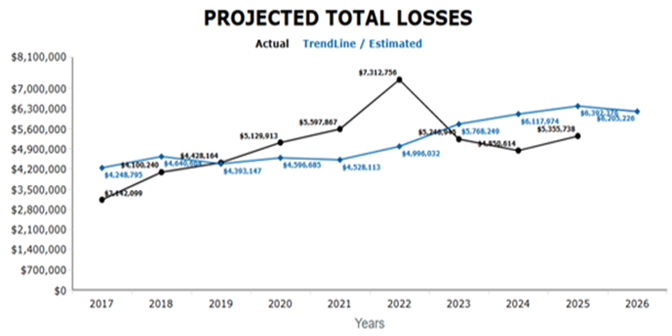
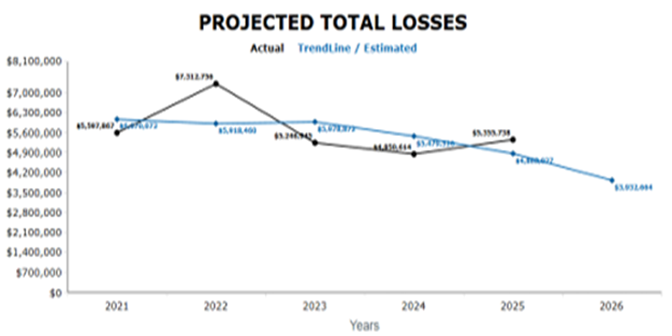
Projected Expected Losses
| Data Set | Projected Losses ($ millions) |
| 2017–25 | $6.2 shown above |
| 2018–25 | $5.7 |
| 2019–25 | $5.1 |
| 2020–25 | $4.6 |
| 2021–25 | $3.9 shown above |
| 2022–25 | $3.4 |
The progressive decline reflects disciplined risk management and bending of the loss curve — a powerful underwriting narrative.
Deliverables
A typical engagement includes:
- Loss Development Reports
- Loss Forecasting Reports
- Layering and retention analyses
- Inflation-adjusted exhibits
- Frequency and severity modeling
- Executive summaries
- Full technical documentation
Total documentation often exceeds 150 pages per engagement.
Who We Work With
RiskMap® Loss Forecasting is particularly valuable for organizations with insurance premiums over $1 million, high collateral requirements, and annual losses that are much less than their annual insurance premiums. Some examples include:
- Large self-insured organizations
- Captive insurance programs
- Risk retention groups
- Broker-led renewal negotiations
- Organizations evaluating retention changes
Next Step (for a review)
For a limited time, RAS is offering free reviews of historical loss data and recent insurance information.
The review will determine if, in RAS’s opinion, a deep dive analysis will likely help reduce potential client’s insurance premiums and/or lower collateral requirements.
Contact RAS for details.