Deeper analysis of historical casualty claims helped Restoration Risk Retention Group confidently increase retention and improve its reinsurance structure — reducing reinsurance costs by more than 15%
Case Study Snapshot
Client: Restoration Risk Retention Group (SERVPRO® franchise insurance program)
Challenge: Better understand historical loss patterns and optimize reinsurance structure
Solution: RiskMap® multi-dimensional claims analysis
Result: Supported retention changes and reduced reinsurance costs by 15%
Client Interview: Mike Connell, Restoration Risk Retention Group
Hear how deeper claims analysis helped the organization confidently increase retention and reduce reinsurance costs by more than 15%.
Introduction
Organizations with substantial historical claims data often bring extensive information to the insurance marketplace. Yet insurance pricing and structure do not always fully reflect the true patterns within that data.
This case study illustrates how deeper claims analytics helped a Risk Retention Group associated with SERVPRO® franchises gain better insight into its loss experience and strengthen its reinsurance strategy.
The Client Situation
The client was Restoration Risk Retention Group, a Vermont-domiciled Risk Retention Group associated with SERVPRO® franchises across the United States.
SERVPRO® franchises provide restoration and remediation services following property damage events such as fire, water, and storm losses. However, the insurance program analyzed in this case focuses on the operational casualty risks of the restoration businesses themselves — not the underlying property damage claims.
The insurance program analyzed in this case study covers the operational casualty risks of the restoration businesses themselves, including:
- Commercial auto accidents involving service vehicles
- Workers’ compensation claims involving restoration workers
- General liability claims arising from restoration operations
- Other operational exposures
Because SERVPRO® franchisees operate nationwide and perform restoration work every day, the program generated a substantial and consistent body of claims data over time.
How the Engagement Began
Restoration Risk Retention Group was introduced to Risk Analysis Services by its captive manager:
Amethyst Captive Insurance Solutions
Burlington, Vermont
The objective was to obtain deeper insight into the organization’s historical loss data and better understand patterns within its claims experience.
Captive Manager Credit
For risk managers, CFOs, and insurance decision-makers, this case study demonstrates that:
- Historical loss data contains insights often missed by standard summaries
- Deeper and better analytics improve both pricing outcomes and internal confidence
- Insurance negotiations are more productive when supported by clear, well-explained evidence (including full audit trails from historical claims data to details of every step in the analysis)
In short, better questions lead to better analysis — and better outcomes.
About the Author
Alan Cantor is a Co-Founder and Chief Data Analyst of Risk Analysis Services LLC.
He has been applying advanced risk analytics for decades, specializing in achieving superior outcomes for organizations with a history of claims, claims data interpretation, loss modeling, and insurance decision support for complex organizations.
Captive Manager Perspective
Analytical Approach
Risk Analysis Services applied its RiskMap® methodology to perform a structured analysis of the organization’s historical loss data. The goal was not to replace actuarial analysis, but to provide additional insight into the underlying behavior of the claims data.
The analysis examined multiple dimensions of the claims experience, including
- Claim frequency and severity patterns
- Loss stratification across retention layers
- Long-term loss trends
- Differences across segments of the program
The goal was not to replace actuarial analysis, but to provide additional insight into the underlying behavior of the claims data.
Key Insights
The analysis revealed several important findings:
- Most loss activity was already occurring within the program’s retained layer
- Loss patterns were more stable than certain projections suggested
- Historical data supported the possibility of increasing retention
These insights helped management better understand how the program’s risk was actually behaving.
Strategic Decisions and Results
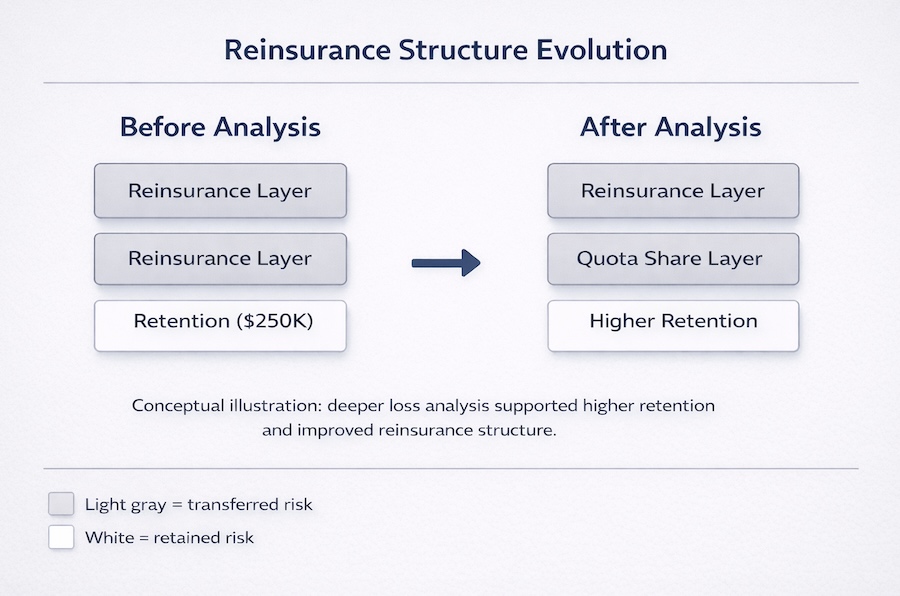
Using these insights, Restoration Risk Retention Group adjusted its reinsurance strategy.
Key changes included:
- Increasing retention levels
- Introducing quota share participation in the working layer
- Aligning the reinsurance structure more closely with historical loss patterns
These decisions ultimately contributed to reinsurance cost reductions exceeding 15%.
Broader Impact
The analysis also helped management communicate its strategy to key stakeholders, including:
- Board members
- Regulators
- Rating agencies
- Reinsurance partners
The organization was able to demonstrate that its decisions were based on clear, data-driven analysis rather than assumptions.
Why This Case Study Matters
For risk managers, captive managers, and insurance decision-makers, this example illustrates that:
- Historical claims data often contains insights not visible in standard summaries
- Deeper analysis can strengthen negotiations with insurers and reinsurers
- Data-driven insights can increase confidence in retention and risk strategy decisions
Related Case Studies
Risk Analysis Services has also applied similar analytical techniques to help organizations better understand their loss data and strengthen insurance decision-making.